
Tribal
Tribal Tattoo Stencil: Edges, Symmetry and Solid Black
Direct answer
A tribal tattoo stencil is a boundary map rather than a drawing: every line you transfer marks the edge of an area you will pack solid, so edge fidelity and symmetry decide the tattoo and nothing inside those edges is stencil information. Pull it in Outline mode rather than Linework, the default, which keeps near-black areas solid; keep Intensity low enough that the thin channels of bare skin between black masses stay open, and never transfer the fill itself. In InkLine, mirror and flip make the symmetry check fast; the printed sheet laid on the actual limb still settles it.
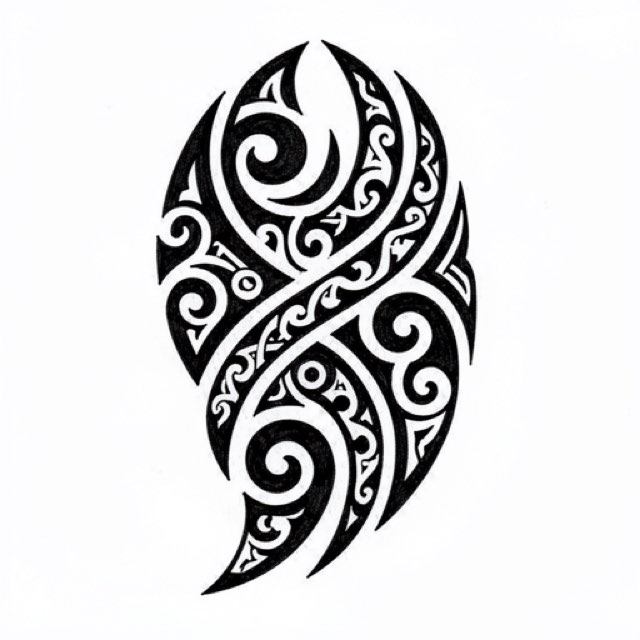
Tribal is the one major style where the stencil and the tattoo are made of different things. Everything else converts a drawing into lines you will follow with a needle. Tribal converts a shape into a fence around an area you are going to flood with solid black. Accept that and most of the settings questions answer themselves, leaving three places the design can actually fail: edges, negative space, and symmetry.
The stencil is a fence, not a drawing
Every mark you transfer here is a boundary between black and skin. The needle covers that line from one side and leaves the other side untouched, which means the stencil line’s position is the tattoo’s shape. Drift a millimeter outward on a curve and the silhouette is a millimeter different forever, with no interior detail anywhere to distract the eye from it. This is the exact inverse of realism, where all the information lives in interior tone and a slightly wrong edge disappears into a gradient. In tribal, one hundred percent of the information is at the boundary and zero percent is inside it.
Three things follow from that, and they are what separate a tribal stencil from every other kind.
| Element | Transfer it | Why |
|---|---|---|
| Outer silhouette edge | Yes | It is literally the shape of the tattoo |
| Negative-space channel edges | Yes, check these first | The pattern only exists because the gaps exist |
| Point and taper tips | Yes, inspect each one individually | The most fragile thing in the extraction and the first thing to blunt with age |
| Solid black interior | No | Pigment mass smears under your hand and hides the edge you are packing to |
| Center axis and registration ticks | Yes, add them by hand | The only way to verify symmetry on the body before you commit |
Keep the stencil line thin and even. Roughly 0.3–0.5 mm on paper at 100 percent scale is the useful window, the range InkLine’s Fine, Medium and Bold settings aim for. The boldness of tribal comes from the packed black, never from the transfer line. A heavy stencil line is ambiguity: a 1.5 mm line is 1.5 mm of doubt about where the black actually starts, and half of it will end up on the wrong side of the fill. Printed as drawn, InkLine’s print screen warns once the typical line will print heavier than 0.8 mm, which a design enlarged to wrap a shoulder reaches quickly.
Never print the fill. A large block of transfer pigment gives you no information the boundary did not, and it costs you: it smudges the moment a glove crosses it, it hides the edge you are following, and it makes the whole sheet harder to judge at a glance.
Add registration marks before you print. Draw a center axis down the symmetry line of the design and two or three short ticks outside the artwork itself, in the margin. On paper they cost nothing. On skin they are the difference between checking symmetry and guessing at it, because once the stencil is down you have no other reference to a straight line. Add them before you set the print size: InkLine trims blank margins and sizes what is left, so the width you type is measured across the ticks, not just the artwork.
What a tribal design is made of
Four properties define the shape language, and none of them involve tone.
Solid black mass with no interior structure. No shading, no color, no line inside the fill. The mass is uniform, so the only visual variable is its outline.
Negative space as a designed element. Half of the composition is untattooed skin, and it is a shape with its own contour, not leftover background. The clearest tell of an amateur tribal design is black shapes drawn first with the skin treated as whatever is left over. The traditions this style borrowed from draw both at the same time, which is why their negative space reads as deliberately as their black does.
Tapering curved bands. A band thickens through the belly of its curve and ends in a point. Constant width reads as a stripe. The taper is the grammar of the whole style, and it is also the part of the design most likely to break during extraction, because the last few millimeters of a point are only a handful of pixels wide in the source.
Interlock and flow. Elements nest inside each other’s curves and echo each other’s direction, either symmetrically across a centerline or in one continuous directional sweep down a limb.
There is a useful consequence for sourcing. Because the design carries no interior information, a low-resolution source still gives you a recognizable overall shape — which fools people into thinking a small image is workable. It is not, and the failure shows up in one specific place: the tips. Zoom into the sharpest point in your source at full magnification. If the taper turns into a staircase of pixels there, the shape is fine and the design is still unusable.
Symmetry: the thing every viewer checks without knowing it
Chest pieces, back pieces and anything crossing the sternum or spine get judged on symmetry within about a second of being seen, by people who could not tell you what they are looking at. It is worth an unusual amount of effort.
Build one half and mirror it in your drawing app before import; InkLine’s mirror flips the whole image rather than copying one half onto the other. Then run the flip-compare check in InkLine: add a mirror step and move back and forth along the step timeline to compare it with the unflipped version. Asymmetries you stopped being able to see after an hour of drawing become obvious instantly.
The harder problem is that the body is not symmetric. Shoulders sit at different heights, one pec usually sits lower than the other, and a relaxed spine is rarely a straight vertical. A perfectly mirrored design aligned to a tape measure will read as crooked artwork on a real person. Mark the anatomical landmarks on skin first — sternal notch and nipple line for a chest piece, the spine and both scapular edges for a back piece — then align your center axis to those.
Transfer in halves. Tribal is uniquely suited to this because its elements are separated by bare skin, so you can cut the printed sheet apart between the masses without cutting through anything. Lay one half, step back three meters, look at it with the client standing naturally rather than braced, and only then commit the second half. The on-skin preview is a visualization, not a measurement of how a design sits on a curved surface, so use it for composition and for showing a client an idea, not for settling a placement argument.
Outline mode, and why Linework is the trap
Outline draws contour lines only — no solid fills, no fine hatching. On a tribal source that discards nothing, because there is nothing inside the shapes to discard. It hands you the fence and only the fence.
Linework is the mistake people make with this style, partly because it is the mode the app starts a new user in and partly because the logic is understandable: the design is black, so keep the black. Linework keeps near-black areas as solid fills, which on a flat black source means the black stays black — a full page of transfer pigment that you then have to work around. Denoised is Linework run on a noise-reduced copy, so it fills the same way; for a grainy phone photograph of a drawing, try Outline with a light Cleanup first. Sketch adds pencil gray the style does not have, and Dotwork and Tonal are built for stippled and shadow-mapped shading, and this style has no shading at all.
The sliders behave in a way that is specific to solid-fill work:
- Intensity is the channel killer. Raising it drives tones toward black and thickens every line inward as well as outward. The narrow channels of skin between two black masses are the thinnest features in the whole image, so they close before anything else does. A closed channel on the stencil becomes a filled channel on skin, and a filled channel turns a designed pattern into a blob. Back Intensity off until the preview looks slightly weak, then inspect the gaps rather than the lines.
- Detail: moderate to high, judged on tips. Do not evaluate this setting on the large curves, which survive anything. Evaluate it by zooming to the sharpest taper in the design and seeing whether the point still comes to a point.
- Cleanup: mostly safe, with one exception. It removes small isolated marks, and in InkLine it is available in Linework, Sketch, Denoised and Outline only. On a tribal source there is no such thing as a legitimate speck, so a light pass is uncontroversial — except that the extreme tip of a long taper can extract as a small detached fragment, which cleanup will then delete. Run it light, then check every point.
If the source is small, or is a photograph rather than artwork, redrawing is often the right call rather than a fallback. Below roughly 1000 px on the long edge a photo cannot be rescued into a clean stencil; you are redrawing, not converting. For most styles that is a real loss. For tribal it frequently is not, because the shapes are geometric and drawable — the photo guide, which puts the original photo under the stencil at an adjustable opacity while you draw, plus an Apple Pencil will usually get you a cleaner result faster than any slider combination. The full decision path across the modes is in which stencil mode for which design.
Placement: draw for the muscle rather than fitting to it
The premise of the style is that the bands follow the muscle underneath and the taper of the limb. A band running across the biceps instead of along it looks wrong even when the drawing itself is good, and no amount of stencil quality fixes a design that was drawn on a rectangle and then applied to a body. The natural homes are the deltoid and upper arm wrapping into the pec, the shoulder cap, the outer calf, and the lat and back.
Curvature hits this style harder than most, for the obvious reason: the design is meant to wrap, so it was drawn flat for a compound surface. Print at 100 percent with no fit-to-page scaling, cut close around the artwork, and lay it on the limb — then check it twice, once with the arm relaxed and hanging naturally and once flexed. A deltoid design that fits perfectly with the arm held out at ninety degrees can bunch and shorten when the arm drops, which is the position it will be seen in for the rest of its life.
Then use the cut-apart technique. Because bare skin separates the masses, you can slice the printed sheet between them and place each segment individually so that each one follows its own piece of anatomy. Transfer them one at a time and check the whole thing before the last piece goes down. Be aware of what this changes: the channels between the segments are now set by your hands rather than by the drawing, so re-measure the narrowest ones after everything is placed. For designs larger than one sheet, InkLine’s multi-page tiling prints across up to 3 × 3 labeled pages on any of five paper sizes from US Letter (215.9 × 279.4 mm) to A3, portrait or landscape. You align them on the registration marks, check the taped master, then cut it apart and transfer section by section — which suits tribal, since you were going to cut it apart anyway. Half-sleeves and back pieces are routinely larger than one page.
Cultural respect: two different things share one word
“Tribal” covers two things that are not the same, and being clear about which one you are making is part of doing the work properly.
The first is a set of living traditions: Samoan tatau, including the pe’a and the malu; Marquesan work; Hawaiian kakau; Maori ta moko; Iban and Kayan tattooing from Borneo; Filipino batok. In these, motifs are not decoration. They can encode genealogy, rank, island or region, family, and specific life events, and some are restricted to particular people or particular circumstances. In Maori practice, ta moko is specific to the wearer’s whakapapa, and kirituhi is the term commonly used for Maori-styled work made for people outside that lineage without those genealogical claims.
The second is the generic blackwork tribal that spread in the 1990s: shape language borrowed from those traditions with the references removed. That is a legitimate blackwork style on its own terms. It is simply not the first thing, and calling it Polynesian to a client is a claim you cannot back up.
Four practical rules at the stencil stage:
- Never trace a photograph of a specific person’s moko or pe’a. It is their record, not a pattern source, and if the artist is living it is also their copyrighted design.
- Do not treat an AI generator as a source of culturally specific patterns. It recombines shapes without knowing which are restricted or what they assert, and confident output is not informed output. The example image on this page is an AI-generated example design rendered by the app, not a photograph of a healed tattoo and not a culturally specific design.
- If a client wants a particular tradition and you are not part of it, saying so and pointing them toward a practitioner within it is a better outcome than an approximation neither of you can read.
- If you are designing generic blackwork in a tribal shape language, tell the client that plainly. Most people are fine with it. What they are not fine with is finding out later.
Honest limits: how solid black ages, and what the app will not do
Black ages well as mass and badly as edge. The fill itself stays dense for decades, while the boundary spreads outward as pigment migrates in the dermis. That produces two predictable failures and both are decided at the stencil stage, not at the machine.
Negative-space channels narrow. A gap that measures 3 mm on today’s stencil is not a gap in twenty years; on a large limb piece, treat something in the 5–8 mm region as your working floor and scale the design up rather than squeezing another element into the space. Points blunt. A needle-sharp taper becomes a rounded stub, so overdraw the sharpness now and accept that it will soften into the shape you actually wanted.
Two things worth telling a client before the session rather than after. Tribal is the default coverup style because solid black covers nearly anything — and the other half of that fact is that a large solid black area is close to permanent, since laser removal on dense black is a long and expensive course rather than a quick one. Large black fields on sun-exposed placements also fade unevenly and can read patchy years later, which is a placement conversation, not a stencil problem.
The tool limits are worth stating flatly too. Below roughly 1000 px on the long edge you are redrawing rather than converting, and neither sharpening nor the optional 2x upscale on import changes that: the upscale resamples the pixels rather than recovering detail, and a staircase taper stays a staircase. The on-skin preview is a visualization, not a measurement. A phone and a home printer do not replace a dedicated thermal stencil printer for shop-volume work; they cover one-off pieces, travel, and apprentice practice, which is a different claim. AI generation needs a network connection, while the stencil processing described on this page runs locally on the device.
On pricing, so nothing is a surprise later: InkLine is a free download; the manual stencil workflow — processing, editing, print layout and export — is free up to an allowance on how many images you carry through it, and needs a subscription past that allowance; AI generation runs on its own credit system. Plan a chest or back piece knowing that, rather than finding it out with a client in the chair.
Frequently asked questions
Which extraction mode is best for a tribal tattoo stencil?
Outline, and it is not close. Outline draws contour lines only and never fills, which gives you exactly the boundary you need around each black mass. Linework, the default mode, is the intuitive choice and the wrong one: it keeps near-black areas as solid fills and hands you a page of solid transfer pigment.
Should the black areas be filled in on the stencil?
No. A filled stencil smears under your hand and glove, obscures the edge you are packing to, and tells you nothing its own boundary did not already tell you. Transfer the outline of each mass and leave the interior blank, exactly as you would for any large solid-black area.
How do I keep a tribal design symmetrical once it is on the body?
Build the symmetry into the artwork by mirroring one half before you import it, check it with a horizontal flip, then place it to anatomical landmarks rather than to a tape measure — sternal notch and nipple line on a chest piece, spine and scapular edges on a back piece. Bodies are not symmetric, so a perfectly mirrored design aligned to the wrong reference reads as crooked artwork. Transfer one half, step back and look, then do the other.
Can I use Polynesian or Maori patterns in a tribal design?
Those are living traditions, not a pattern library, and their motifs can encode genealogy, rank and family. In Maori practice, ta moko is specific to the wearer's whakapapa, while kirituhi is the term commonly used for Maori-styled work made for people outside that lineage. Never trace a photograph of a specific person's moko or pe'a, and if a client wants a specific tradition you are not part of, referring them to a practitioner within it is the better outcome.
How does tribal blackwork age compared to line-based styles?
Solid black ages well as mass and badly as edge. The fill stays black for decades while the boundary creeps outward, so the narrow skin channels between elements close up and sharp taper points blunt into stubs. Design the negative space wider than looks right today and overdraw the sharpness of every point.